Monday, July 24, 2006

Diaperpunishment For My Spn


ALASKA
Did you know that Alaska is four times larger and ten times less inhabitants than Switzerland? With the same population density is likely to Switzerland are only 17,500 inhabitants, or less than the city of Solothurn.
Alaska has more than Half of the glacier mass of the entire world. The coastline is 53,000 km, ie more than the circumference of the earth.
Why eat ice cream in winter, people here? To warm up! The outside temperature is -50 ° Celsius, the ice cream is -15 ° warm, you expect!

On Thursday, 13.7., We picked our sister and sister-in at the airport Brigitte Fairbanks. It will spend nearly three weeks together with us in Alaska. The next day we drove to Denali National Park (NP).

OF THE wolves howled
four nights we spend in Denali NP, and that so far inside the park, such as mobile homes are permitted. The space we reserved in February. We must do so without the blessings of civilization, such as water manage, electricity, public flush toilets and showers and are dependent on the few gallons of water in our tank. For us to the seclusion of a few unforgettable experiences.
With an official bus, an old rickety school bus, we drive back to Wonder Lake and twice, ie each 175 km on dirt roads. The tour takes - including maintenance - nine hours. But it is entertaining: the vastness of the landscape, the infinitely long and wide, crisscrossed by gravel banks of river valleys, the mountains shimmering in all mineral colors, the varied green of tundra and taiga, the glaciers, the debris covered and at the end of overgrown grass, are the small bog ponds where beavers build their castle, ducks cavort and where short-eared owls move to prey peering in circles, always capture our attention. Most curious of course we are on animal encounters.
On the second day's drive we have an excellent Buschauffeurin that goes by professional school bus and apparently is accustomed to deal with children and adults. It gives us a lot of information, moves quickly and looks bears at a distance of one kilometer. If she sees something, we need to open the window while driving, behave quietly, not talking, not lean out the window, etc. The window may we "zuschletzen" again when the bus is hit and the sound is drowned out by engine noise. We obey her good, because we are experiencing something. Following these instructions led us to the best observations. We drive to Wonder Lake and back. The weather is nicer than the two days before, and the long drive worth it this time. At various points we see bears, only two out of only 150 m distance. Also, we are witnessing a moose grazing in the marshy tundra.

The most beautiful experience, however, are the wolves. Shortly after the Toklat River, three Wolves against us on the road. A bus has been before us held. The gray wolf disappears, but a black wolf and a white wolf, the alpha animal that has thrown in the early summer, go slowly and close past our bus. We behave very quiet, the windows open, but also do not reject us! The wolves are reluctant because a bus has kept us behind, lean out from the windows of the people themselves. The white wolf is like a little dog like the grass, the black scratches in the bushes.

Then both walk slowly back patterns, the bus, stay in front of us want to start on the road and cry, always sings the she-wolf, the howling, the wolf in the good mind. 40 tourists, we heard breathless. The tone we can capture with your digital camera. After this - priceless! - Presentation of the wolves move back. They were, as we are told later, in search of a young caribou. Perhaps the two parents of the six puppies (four black, two white) are that we can observe on the way back in the river bed. There, they play and wrestle, as it should be for young wolves. To conclude with a walk-family Willow Ptarmigan (Partridge) out of the bushes onto the street and four young parents.


TRAVEL INS MAT-SU VALLEY (north of Anchorage)
Before our departure road from the Denali National Park we will visit in depth the very first visitor center opened at the park entrance, which is of course made great. The exhibition gives particular insight into the world and the problems of the animals we have seen in recent days.
Then we drive off at four clock. The trip takes the time being the Nenana River, after crossing the Broad Pass (701 m) the Chulitna River, out alternately through tundra and taiga, the eastern edge is always along the Alaska Range. About six clock, we arrive at the Denali Viewpoint North, a large parking lot above the flood plain of the Chulitna with charts and views of the Alaska Range. Denali (Mount McKinley) is shown in the evening in part of the clouds. The next morning we make
after half an hour stop at the newly established Denali Viewpoint South, where we turn on a coffee break. The Denali and the surrounding mountains show is now wonderful, a bit cloudy around. A short trail leads up a hill from which are also the valley of the Chulitna and the mighty Ruth Glacier to see. On Lake
Kashwitna we make a short stop and enjoy the view of the quiet surface on which reflected the forest and mountains. In Houston, we eat at the small restaurant on the terrace overlooking a small lake. The vegetation patches on the lawn originate from the moose that stayed here until the spring of the night.
take the Homestead RV Park Palmer at our lodging for three nights.


ANCHORAGE
In downtown Anchorage, we look far for a suitable parking place. We need to show and pay for two, which, as it turns out later, right. For the large parking lot at the station, where we park, finally some time, we note in the evening that three campers who had occupied two, three or even only a few inches of another car park and only one paid at up to three parking tickets of windshield had. Three and a half
Hours is devoted to the most interesting Anchorage Museum of History and admire Art We paintings, including the lay missionary and painter, Eustace Paul Ziegler, a variety of carved from the teeth of the walrus art objects, the temporary exhibitions of birds (owls, eagles, hawks, falcons ). We are interested above all the upper story: History of Alaska. First settlement via Bering Strait, lifestyle of the locals, Discoveries of the Russians and Western Europeans, the life of the miners, construction of railways, pipeline, etc. Life-like dwellings made of wood, or skins with the people in the former clothing with all sorts of tools and fixtures makes us the past alive.


IN THE GARAGE
also an RV need an occasional audit. After 9,000 miles driving a larger service is due. We have registered him in a garage in Eagle River a few weeks ago. During this work, we are, of course, no home ', that is, we are excluded, and just wait somewhere until the car is ready to travel again. We expected a wait of 2 hours. But we will soon informed that it takes even up to 11 clock. We go shopping and walk around and meet at 11.30 in the garage again, take to the RV in reception. As a nasty surprise waiting for us: from brake pads for the front brakes were only 20% available, which is not sufficient to California. We will put off at 16 clock, the brake pads ARE OF only one in the afternoon. We go eat and come back and talk to the mechanic: The brake pads typically last 25,000 - 30,000 miles, ie the taking over the pads were already worn right. We are angry because we feel verschaukelt and because we lose a whole day. We take a walk through the village, look at the houses and gardens, we buy quickly decided a house - apparently we have done that, as the name tag points to the photo - and come back by 15 clock sitting in the office, read, seek launched Magazines frantically Sudokus by drinking coffee and looking at his points on our watches. Only by 17 clock does it all. We pay the bill with his eyes closed and head back.


WALK WITH CORINA Corina
, the daughter of a friend of Esther, has lived 14 years in Alaska. On Saturday, 22.7. brings us with her colleague, Nina, a home economics teacher from Sils iD, who spends her vacations in Alaska, to the campground from. Included is Corina lively little dog Tobi, which will temporarily while driving due to insufficient space for lap dogs. We travel with them to Hatcher Pass, where we and a group of a dozen people take a short hike up a mountain. The weather brightens up slowly, and we do have a beautiful view of the surrounding mountains, which remind very much of the Engadine in the south of the valley of the Knik River and east of the valley of the Matanuska River. But there are no cows or sheep! How do we get back down, is Tobi, who is constantly running up and down the mountain on not there. Esther makes the binoculars on the top of the mountain. Tobi is untrue to ourselves and other people followed. Corina has no alternative than to take the tour again - as it has shown us her dog! Thank God there are just 280 meters. Finally, the whole family is reunited. shows on the way back Corina us their newly acquired, pretty, surrounded by woods house and invites us for coffee. The beautiful day we decide with an early dinner at an Indonesian restaurant. On Sunday Corina Nina flies to Katmai to watch the bears fishing for salmon, and we will go through Anchorage to Kenai Peninsula, where we will stay for eight days.

PS As Mr. Blog "on Sunday in an Internet cafe was not yet ready to publish our report, it now appears a little late from Seward.

Tuesday, July 11, 2006

Chevy Silverado 427 Price

Whitehorse (Yukon, Canada) to Fairbanks (Alaska)


Preliminary note: Unfortunately, the layout corresponds to the published news or our Still do what Mister blog in the preview of the draft dazzled us in each case. One may therefore overlook the lack of integration of the photos.

RECYCLING à la Canadienne
Since the drinking water in North America inedible because of the strong chlorine addition and / or ozonation, we buy a plethora of in pet bottles or tetra packs bottled drinks. On each PET bottles, even on milk cartons in Canada will be charged a fee for recycling and a depot. Custodian fees we had in Switzerland so have a go. The empty containers could easily return in the Migros and Coop and elsewhere. We collect the empty packaging good, until we are in sheer plastic RV hardly move anymore. We forget that is for every purchase to return the empties, until we advance again in White Horse in a supermarket with a shopping cart full of cargo. But we will not get rid of our bulky. Neither the fund nor the customer service they are willing to take back the empties. You can not tell us where we could return it. The (Swiss) head of our Camp Grounds finally called us the address of the recycling center. We are curious how this works in Canada, and drive the extra few miles to the assembly center in the suburbs. In fact, the collected is received. We meet the locals with huge amounts of Alubüchsen and bottles. These are all counted separately and the total fees paid to the custodian - a complex work that brings but not much, when we see the drop at picnic areas. We waive the right to praise the Swiss system and set up collection points throughout, and in the future, like most Canadians container into the garbage.


ON THE KLONDIKE HIGHWAY (from Whitehorse to Dawson City)
On Tuesday, 4 July, we drive away in Whitehorse. We left the Alaska Highway (# 1), go to the north on the Klondike Highway (# 2) to the gold rush town of Dawson City. We are not moving much, because after a few miles, we make a detour to Takhini Hot Springs to let us go and relax in the spa. Just before the bath, we see a farm with large-scale wild animal enclosures. Head of the Swiss Evelyne leads us on a two-hour ride through the terrain. As we'll see at close range elk, bison, musk oxen, Mountain Goats, Bighorn Sheep, Stone Sheep, etc. The welfare of animals kept in spacious grounds largely their natural behavior.

The next day we drive on the Klondike Highway. The road is good, has little bumps (caused by frost, although the road is built on an elevated route), on both sides a good 15 m wide strip so Wild animals are perceived in time. The traffic is very weak. On average, every 10 miles we crossed a vehicle.

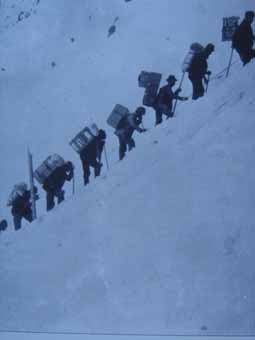
We are in a historic way. As in 1896, three prospectors (geologist who searched for gold, silver and other ores) on a tributary of the Yukon, the Klondike, gold and found in July 1897 arrived with a huge load of gold (each about a ton) in Portland and San Francisco, dissolved The news of this hysteria, the Klondikitis out. A few days later, thousands on the way north to try their luck as a gold digger (Stampeders). By boat they went to Skagway. The Canadian border police were alerted and asked that any gold mining material bring along a ton of weight to take care of themselves can. During the winter, procured the gold rush, the material and carried it in laborious climb up the Chilkoot Pass or the longer White Pass. The image with the long column, which sought a fixed rope up the steep hill, is known worldwide. On the north side, they waited until the ice of Lake Bennett had melted, and then went on homemade fins and ships to Whitehorse. Here, the dangerous rapids Miles Canyon was to drive through, where some lost their belongings or even their lives. From White Horse then paddle steamer sailed downstream to Dawson City, at the mouth the Klondike in the Yukon is. 100,000 people had come to Skagway, many gave up the Chilkoot Pass. 30,000 arrived in the early summer of 1898 to Dawson City, many late because the claims (staked grave sites) were already taken.
One of these daring robbery and adventurer was one of the then 21 year old Jack London (born John Griffith), who went down with a homemade raft down the Yukon. He was, however, for the time being not to Dawson City, as the Yukon at the mouth of Stewart River, so about 100 km from the finish froze. In an abandoned trapper cabin Jack London lived with three other robbery a harsh winter with temperatures down to -60 degrees. Trappers and Indians would occasionally come to this Hut, and during the long winter nights, they told of their experiences. The encounter with these people gave Jack London the substance of his stories, that is probably most famous, The Call of the Wild '.
Year-on has changed the landscape of the Klondike Stampeders from 30,000 in full: a city had emerged, cut down the forests on a large radius. They needed the wood for house construction, to be fetched for cooking and heating, for equipment for gold mining, drilling of wells, etc. Very soon they had the gold from the depths of the bedrock (Placer gold). This dug out wells. Because the ground was frozen even in summer, fire was set. When the timber ran out, one worked by steam. Soon, a 51 km long railway line was built. But the gold fever broke up soon in smoke. Only with large machines could be mined productive. After all, was mined here until 1966, gold worth 300 million Canadian dollars. Today the stone heaps piling miles through the valley.
order to facilitate the arduous climb up the Chilkoot Pass, was set up a steam lift. In 1898 they built a rail link from Skagway over the White Pass to Carcross and then on to Whitehorse. The construction of this narrow-gauge railway claimed nearly a year! We are the imposing mountain route from Skagway to White Pass on 10 August ride. Report follows. The railway company
White Pass & Yukon Railway was obliged to build from Whitehorse to Dawson City is a all-weather road and entertain. For the 540 km route takes you five days. The horses were changed at the latest after 50 km. In winter you drove on the track with the sled. The old road and some stations we see on our trip.

We of course take a little bit faster than the horse-drawn vehicles and need for the trip from Whitehorse to Dawson City for four days. Since there is little traffic, we drive slowly up and even make a detour to the Silver Trail to Mayo. This procedure is worthwhile. One morning we see an animal slowly Cross the street. We stop. It is a Canadian lynx. He gets five yards up the slope right, waits, turns around, spits, looks back and then disappear, probably because he saw the two cars that overtake us now. A sensation!
The Silver Trail, where literally the middle of nowhere say good night, we see not only these two animals - presumably they have just said good morning - but also a family of bears. First, we see only a young one. Again, we stop and see along the road a mother bear with two brown boys who would be around two years old. We are very excited and forget, as for the lynx, the camera to pull out. But these experiences, we will retain no image in memory.

We also drive through large areas of forest fire. The carelessness of campers - the mania of the Camp Fire, we have previously reported - was prompted in 1998 a large fire that was extinguished until the following year in full. Even in the chilly winter motet the fire continued in the deep peat-soil. The fire itself is indeed necessary for healthy vegetation and is usually caused by lightning. More frequently, however, fires caused by carelessness. After the fire appear first Fireweed (willow herb), then Willows (Willow), Aspen (quaking aspen, Populus tremuloides) and balsam poplar (Populus balsamifera - we are grateful for the Dictionnary in the dock of our Powerbook!). Only 150 to 300 years later, conifers have replaced the hardwood trees and the landscape returned to its original vegetation. We just read that there are in Alaska each year 600 fires, 400 of which are triggered by people!

Before Dawson City, there is a construction site. At a length of over 20 km we go - thank goodness, largely without oncoming traffic - usually on a wet dirt road. Although we can usually leave quickly, up to 80 km / hr., But our car will receive up to a height of 1 m, a brown patina. The last few miles surround the expansive stone heaps Street - remains the gold diggers.


IN DAWSON CITY
The museum shows us in great detail the life of the gold rush. We are back in the year 1898. The many available for purchase books about life 100 years ago, the fate of the miners, biographies of hard-working women are very interested, but the nights are too short to read, and our baggage will be limited kg total 92nd We see a gripping documentary on the life in Dawson City.
Since the Yukon is very wide here and the road practically serves only to tourism, we decided not to build a bridge. A ferry also carries great cars day and night free of charge on the other side of river.


ON THE TOP OF THE WORLD HIGHWAY TO ALASKA
The trip from Dawson City to Alaska via a road worthy of the name. The route is not in a valley along a river, which would be topographically quite costly, but as a trail along the ridges. So we might be able to enjoy top 'views of mountains and river valleys. Could we, if not for the road would be bumpy. Of the 175 km to Chicken (Alaska) are good 150 km gravel road, with corrugated grooves, potholes, loose gravel. Thanks to the rain the night before the dust is limited. And since there is virtually no oncoming traffic, we need this time to replace a glass.
In Chicken, with 36 inhabitants, the first town in Alaska, apparently to stay without water or telephone, we returned to the United States. Urs makes itself equal to gold washing. The surprising success is documented by photographs.


KARBUHERDE AM THE RIVER Fortymile
Since Dawson City, we are in the catchment of a tributary of the Yukon, the Fortymile River, renowned for the caribou (Fortymile caribou herd) are known. Only around 1920 the herd consisted of about half a million animals lived in a vast area of tundra. In April they moved each hundreds of miles westward, where the females calving, and then draw the same with their boys on. A calf is 24 hours after his birth already keep up with the herd. In the summer they moved to the mountains to escape the pesky mosquitoes and other parasites. Crossing the icy waters of rivers, some drowned, others were a prey to the wolves - a wolf about 20 caribou tears per year - also the Indians, who used virtually all parts of this game, but unfortunately, the White, who within a few decades, the caribou almost eradicated. In 1920 there were just 6,500 caribou. As the Wolves lost their main food source, they starved to death or torn more moose. Thus, the white next to the caribou has decimated indirectly, the wolf and the moose. But the number of wolverine, coyote, fox, raven and other birds that lived on the caribou and moose AASR dropped sharply. Thanks to special protection measures increased the population of caribou again in 1990 to 23,000 today and is expected to be strong against 40,000. The problem is not solved but hunting ban. The vast forest fires are the caribou for their part, the main food source, the lichens. We like the view in 2004 by a devastating fire destroyed forests on both sides of the Taylor Highway, and are not happy, finally healthy forests to behold.

The remaining route to Tok to Fairbanks is simpler. Nevertheless, we take us for three days and take the first one on Wednesday, 12.7., In Fairbanks. On the way we find in Delta Junction, the official end of the Alaska Highway, an Internet connection and can therefore publish this message.

From Friday we'll be in Denali National Park at the foot of Mt McKinley. If we spare the wolves and grizzlies, will follow eight to ten days, a new report.

Monday, July 3, 2006

Sleep With Heater On Sinus

OF THE ALASKA HIGHWAY


From Quesnel we continue on the # 97 that leads to Dawson Creek to Watson Lake. From Dawson Creek, however, it is now called the Alaska Highway. We leave Dawson Creek, however, are right, you cross the # 29 of Chetwyn about Hudson's Hope (Bennett Dam) to Fort St. John and takes you to a shorter path to the Alaska Highway.

On the south shore of Lake McLeod, we find a nice spot on the lake shore. Only an elderly couple there. We enjoy the peace and observe the lake. A Bald Eagle is flying next to us a round, only 10 m! Esther watched from her window from the hustle and bustle of several beavers. A hummingbird sits nearby on a branch. There is absolutely no wind. The lake is smooth as glass, and because he is dark, the evening sky reflects almost 100%. Sorry, can also Camp Fire, the mosquitoes do not distribute.
morning It is quite cool, and the lake has small waves. In the distance we see a moose grazing. A Golden Eagle bathing on the shore. Intensive shakes its wings in the water and then flies away. Sits on a branch of the Bald Eagle, we have observed the night before.

on Cameron Lake, we stay in a small, simple campground. The location is wonderful. We are almost alone. The sun is warm, we can warm up the bed sheets in the sun. I swim in the lake, we read on the shore and watch beavers, the dive with an audible tail shock, watch fish jump up and snapping at flies. Mosquitoes, it has apparently not. But geradeso are annoying the neighbors, the sit outside, have visitors and can run until midnight on the radio and talk.

We now alone on the # 29 A coyote is on the road. He apparently wants to cross the street. We keep on the right side of the road. He is watching us - we. Finally he decides to go over. Over there he stops, looks at us again, takes a few steps, but looking back it always. Then he stops, goes behind a hill. We drive a little further to see him come out again over the hill and cross the street. On the roadside, he continues, do not take a look around without being marked his territory and finally disappeared in the bushes.

From Hudson's Hope we go to the Bennett Dam, where we take a guided tour at 10.30 clock in the WAC Bennett Dam. With a bus we drive into the underground power station and see where the room with the ten 80-tonne turbines, and the room where the water is discharged from the turbines. This water is there a temperature of only 1.5 °. The dam itself, the core of sand and the shell material from the moraine consists of a 5 km away, is about 2 km long. The sand core is saturated with water and gives the dam stability. The dam has a length of 350 km. The fish leave the lake through the turbines! 10% pay these dizzying carousel ride apparently with his life. The others are later so confused or stunned that they are easy prey for birds of prey in the Peace River. The power plant provides a peak performance of 2.7 million KW and supplies a large part of BC with energy. Power lines leading up to Vancouver.


ENCOUNTER WITH MOOSE
We drive on the Alaska Highway. At long range I mean a dark-suited man to see with a dog. Not impossible, since we have also overhauled a cyclist. But then I remember the strange swaying gait on this wall. Finally, they turn out to be a cow elk with boys. We slow down our journey. The moose ambling along the roadside and then disappear in the bushes. The next day I mean in the river beside the road a canoeist to see. However, it is a moose, by the river swims. We slow down the ride and stop just before the spot where the moose comes up the embankment. In fact: Five yards from us, they come up dripping, staring at us blankly and then plods on in its gangly gait. Even in Caesars Bellum Gallicum is written (but not of Caesar's hand) that moose are in the truest sense of the word clumsy animals. Because they have no knees, they could not lie down to sleep, but were leaning against a tree. To hunt the elk, the Teutons, the, sleeping trees had 'been cut slightly. Then, when a moose on the tree was leaning, he had fallen along with the tree and could be easily caught.
That reminds me, the amusing description of Bill Bryson (Highlights from America, Goldmann) Reviews
"The moose is the most curious, pathetic helpless creature that has ever lived in the wild! He may be huge - as big as a horse - but incredibly awkward. A moose runs when the left leg does not know what the right do. Even his antlers makes her nothing. Other creatures can grow horns with pointed ends that look in profile sumptuously and extort the enemy respect. The moose, however trots with an antler through the area that looks like a glove pot holder. Above all, the animal is distinguished from an almost boundless lack of intelligence. If you drive along a highway and enters a moose from the woods, he winks at you a whole minute long and then suddenly runs away from you, but along the road. The legs fly simultaneously in eight different directions. "


ON ALCAN (= Canadian part of the Alaska Highway)
Since Fort St. John we encounter on the Alaska Highway, which we now follow the next 1,400 km (to White Horse). To Fort Nelson, he formed a 60 m wide band through the endless forest. The further we go, the more varied the route. We cross raging rivers, deep blue ride Lakes along to see even with snow-capped mountains - and more than 1400 km!
The Alaska Highway was built in 1942 within six months, but was initially only passable with tracked vehicles. The Japanese threat to the United States finally gave the more or less reasonable excuse for the construction, which could not oppose Canada. The length was 2288 km (from Dawson Creek to Delta Junction). Today's new trackbed is about 60 km shorter, we see again the old tracks. We think most of the traces of the 2000 year old Roman roads.
The first two days we travel 300 km. One can easily drive 100 km / h, because the swath is a certainty. Then we take it easy. There is little traffic and we can hold in many places. We have still 14 days left for the remaining 1600 km! Fast overtake us nor the cyclists, of which we come across a few stalwarts. Inevitably, we think of the movie, Grumpy Old Men '(with Jack Lemmon and Walter Matthau).
on our short walks we see some flowers, among many others, the white and yellow lady's slipper.
Even animals we see, first run over, then, thank God, only surviving deer, elk, Cariboo, black bears, bison, Dall sheep and of course, mosquitoes. The front of the car is littered with dead insects, unfortunately, with a few large dovetails.
A Loon, an excellent diver races, according to the Summit Lake like a turbo with strong wing beats a fish.
The weather is crazy: At mile 47 (Fort St. John), it is warm 32 degrees, after 2 days at the Summit Pass (1295 m with the highest point of the highway) 6 degree cold with rain and sleet. In White Horse again for several days over 30 degrees. And the sun will not go down easy. It is 23.15 clock.

EXCLUDED!
Am 28.6. done what we had always feared, because we do not have a spare key, we have excluded ourselves. At a photo stop we get off briefly to photograph Dall sheep, and leave the ignition key, depend on which all other keys stuck and can only open a car door. As the wind strikes the door - and we remain outside. Our bad luck for the door lock was on, put lock ', which means automatic closing. It is cold, a biting wind is blowing, we begin to feel cold and have nothing with us as the camera and Esther's fanny pack (which it stores just for sleeping!). Esther is on the road and stops at the next car. A Ami stops immediately and is working with a wire bar to unlock the disk along the door - without success. He had just been a car thief, but FBI officials. It's getting uncomfortable. Another car holds and takes us to thank God, with only a mile away, Rocky Mountain Lodge, a somewhat run-down gas station, is only frequented by motorcyclists. The owner travels with us to our RV, suggests a small window, which in 1000 shattered pieces and sticks to a film (but without the dirt under the adhesive tape to remove before). We have to go as quickly as possible to 500 miles away White Horse, to repair the disk.
We drive off. An hour before Watson Lake begins to rain. We are in a real downpour. As a precaution, we had just before, when we saw the storm approaching, the window also isolated with tapes. But the heavy rain, penetrates and Esther sits the last driving lesson on her bed and is busy mopping up the water come urgent. In Watson Lake
I fit a Styrofoam plate from inside the window frame. Almost two months ago, I had received in Durango in a hobby market Styrofoam to tinker Esther's bed for a wedge. The rest of the styrofoam plate to fit random millimeter in the window frame. Sealed with tape and see. Now we are ready for the biggest tornado.
The next day is sunny. We arrive for another 500 km drive in White Horse, looking for - at the very last minute - to a glass shop and can be used as an intermediate solution, a plexiglass plate. Had we arrived 10 minutes later, we would have to wait until Tuesday. Canada Day is on Saturday, and as do many a long weekend.
Esther managed from now on, the keys of the kingdom, that the RV door.

soon we have forgotten our bad luck. Within two days because we had to drive 800 km, we have a few days remain ahead of our program, and as the weather is summery warm, we did a few days in the beautiful White Horse Area. The area we like very much: the traveling Yukon, the scent of wild roses on the long shores, the still snow-capped mountain peaks, the warm sun, which is the first clock at 23.15 and we by bedtime keeps.
We drive on the southern section of the Klondike Highway, admire the turquoise waters of Emerald Lake, hike through the smallest desert, the Carcross visit Desert, the town of Carcross, finish of today's White Pass & Yukon Railway and the legendary Chilkoot Pass Trail, admire the Atlin Lake etc. ...
But now I want to close, or swallows the Lord does not blog long report. Maybe we will get back in Dawson City and then safely back in Alaska.