
Preliminary note: Unfortunately, the layout corresponds to the published news or our Still do what Mister blog in the preview of the draft dazzled us in each case. One may therefore overlook the lack of integration of the photos.
RECYCLING à la Canadienne
Since the drinking water in North America inedible because of the strong chlorine addition and / or ozonation, we buy a plethora of in pet bottles or tetra packs bottled drinks. On each PET bottles, even on milk cartons in Canada will be charged a fee for recycling and a depot. Custodian fees we had in Switzerland so have a go. The empty containers could easily return in the Migros and Coop and elsewhere. We collect the empty packaging good, until we are in sheer plastic RV hardly move anymore. We forget that is for every purchase to return the empties, until we advance again in White Horse in a supermarket with a shopping cart full of cargo. But we will not get rid of our bulky. Neither the fund nor the customer service they are willing to take back the empties. You can not tell us where we could return it. The (Swiss) head of our Camp Grounds finally called us the address of the recycling center. We are curious how this works in Canada, and drive the extra few miles to the assembly center in the suburbs. In fact, the collected is received. We meet the locals with huge amounts of Alubüchsen and bottles. These are all counted separately and the total fees paid to the custodian - a complex work that brings but not much, when we see the drop at picnic areas. We waive the right to praise the Swiss system and set up collection points throughout, and in the future, like most Canadians container into the garbage.
ON THE KLONDIKE HIGHWAY (from Whitehorse to Dawson City)
On Tuesday, 4 July, we drive away in Whitehorse. We left the Alaska Highway (# 1), go to the north on the Klondike Highway (# 2) to the gold rush town of Dawson City. We are not moving much, because after a few miles, we make a detour to Takhini Hot Springs to let us go and relax in the spa. Just before the bath, we see a farm with large-scale wild animal enclosures. Head of the Swiss Evelyne leads us on a two-hour ride through the terrain. As we'll see at close range elk, bison, musk oxen, Mountain Goats, Bighorn Sheep, Stone Sheep, etc. The welfare of animals kept in spacious grounds largely their natural behavior.

The next day we drive on the Klondike Highway. The road is good, has little bumps (caused by frost, although the road is built on an elevated route), on both sides a good 15 m wide strip so Wild animals are perceived in time. The traffic is very weak. On average, every 10 miles we crossed a vehicle.
We are in a historic way. As in 1896, three prospectors (geologist who searched for gold, silver and other ores) on a tributary of the Yukon, the Klondike, gold and found in July 1897 arrived with a huge load of gold (each about a ton) in Portland and San Francisco, dissolved The news of this hysteria, the Klondikitis out. A few days later, thousands on the way north to try their luck as a gold digger (Stampeders). By boat they went to Skagway. The Canadian border police were alerted and asked that any gold mining material bring along a ton of weight to take care of themselves can. During the winter, procured the gold rush, the material and carried it in laborious climb up the Chilkoot Pass or the longer White Pass.
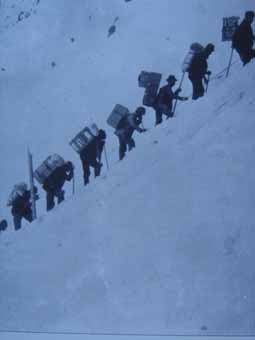 The image with the long column, which sought a fixed rope up the steep hill, is known worldwide. On the north side, they waited until the ice of Lake Bennett had melted, and then went on homemade fins and ships to Whitehorse. Here, the dangerous rapids Miles Canyon was to drive through, where some lost their belongings or even their lives. From White Horse then paddle steamer sailed downstream to Dawson City, at the mouth the Klondike in the Yukon is. 100,000 people had come to Skagway, many gave up the Chilkoot Pass. 30,000 arrived in the early summer of 1898 to Dawson City, many late because the claims (staked grave sites) were already taken.
 One of these daring robbery and adventurer was one of the then 21 year old Jack London (born John Griffith), who went down with a homemade raft down the Yukon. He was, however, for the time being not to Dawson City, as the Yukon at the mouth of Stewart River, so about 100 km from the finish froze. In an abandoned trapper cabin Jack London lived with three other robbery a harsh winter with temperatures down to -60 degrees. Trappers and Indians would occasionally come to this Hut, and during the long winter nights, they told of their experiences. The encounter with these people gave Jack London the substance of his stories, that is probably most famous, The Call of the Wild '.
Year-on has changed the landscape of the Klondike Stampeders from 30,000 in full: a city had emerged, cut down the forests on a large radius. They needed the wood for house construction, to be fetched for cooking and heating, for equipment for gold mining, drilling of wells, etc. Very soon they had the gold from the depths of the bedrock (Placer gold). This dug out wells. Because the ground was frozen even in summer, fire was set. When the timber ran out, one worked by steam. Soon, a 51 km long railway line was built. But the gold fever broke up soon in smoke. Only with large machines could be mined productive. After all, was mined here until 1966, gold worth 300 million Canadian dollars. Today the stone heaps piling miles through the valley.
order to facilitate the arduous climb up the Chilkoot Pass, was set up a steam lift. In 1898 they built a rail link from Skagway over the White Pass to Carcross and then on to Whitehorse. The construction of this narrow-gauge railway claimed nearly a year! We are the imposing mountain route from Skagway to White Pass on 10 August ride. Report follows. The railway company
White Pass & Yukon Railway was obliged to build from Whitehorse to Dawson City is a all-weather road and entertain. For the 540 km route takes you five days. The horses were changed at the latest after 50 km. In winter you drove on the track with the sled. The old road and some stations we see on our trip.
We of course take a little bit faster than the horse-drawn vehicles and need for the trip from Whitehorse to Dawson City for four days. Since there is little traffic, we drive slowly up and even make a detour to the Silver Trail to Mayo. This procedure is worthwhile. One morning we see an animal slowly Cross the street. We stop. It is a Canadian lynx. He gets five yards up the slope right, waits, turns around, spits, looks back and then disappear, probably because he saw the two cars that overtake us now. A sensation!
The Silver Trail, where literally the middle of nowhere say good night, we see not only these two animals - presumably they have just said good morning - but also a family of bears. First, we see only a young one. Again, we stop and see along the road a mother bear with two brown boys who would be around two years old. We are very excited and forget, as for the lynx, the camera to pull out. But these experiences, we will retain no image in memory.
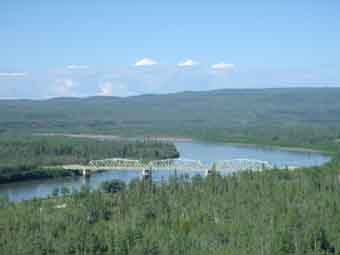
We also drive through large areas of forest fire. The carelessness of campers - the mania of the Camp Fire, we have previously reported - was prompted in 1998 a large fire that was extinguished until the following year in full. Even in the chilly winter motet the fire continued in the deep peat-soil. The fire itself is indeed necessary for healthy vegetation and is usually caused by lightning. More frequently, however, fires caused by carelessness. After the fire appear first Fireweed (willow herb), then Willows (Willow), Aspen (quaking aspen, Populus tremuloides) and balsam poplar (Populus balsamifera - we are grateful for the Dictionnary in the dock of our Powerbook!). Only 150 to 300 years later, conifers have replaced the hardwood trees and the landscape returned to its original vegetation. We just read that there are in Alaska each year 600 fires, 400 of which are triggered by people!
Before Dawson City, there is a construction site. At a length of over 20 km we go - thank goodness, largely without oncoming traffic - usually on a wet dirt road. Although we can usually leave quickly, up to 80 km / hr., But our car will receive up to a height of 1 m, a brown patina. The last few miles surround the expansive stone heaps Street - remains the gold diggers.


IN DAWSON CITY
The museum shows us in great detail the life of the gold rush. We are back in the year 1898. The many available for purchase books about life 100 years ago, the fate of the miners, biographies of hard-working women are very interested, but the nights are too short to read, and our baggage will be limited kg total 92nd We see a gripping documentary on the life in Dawson City.
Since the Yukon is very wide here and the road practically serves only to tourism, we decided not to build a bridge. A ferry also carries great cars day and night free of charge on the other side of river.


ON THE TOP OF THE WORLD HIGHWAY TO ALASKA
The trip from Dawson City to Alaska via a road worthy of the name. The route is not in a valley along a river, which would be topographically quite costly, but as a trail along the ridges. So we might be able to enjoy top 'views of mountains and river valleys. Could we, if not for the road would be bumpy. Of the 175 km to Chicken (Alaska) are good 150 km gravel road, with corrugated grooves, potholes, loose gravel. Thanks to the rain the night before the dust is limited. And since there is virtually no oncoming traffic, we need this time to replace a glass.
In Chicken, with 36 inhabitants, the first town in Alaska, apparently to stay without water or telephone, we returned to the United States. Urs makes itself equal to gold washing. The surprising success is documented by photographs.

KARBUHERDE AM THE RIVER Fortymile
Since Dawson City, we are in the catchment of a tributary of the Yukon, the Fortymile River, renowned for the caribou (Fortymile caribou herd) are known. Only around 1920 the herd consisted of about half a million animals lived in a vast area of tundra. In April they moved each hundreds of miles westward, where the females calving, and then draw the same with their boys on. A calf is 24 hours after his birth already keep up with the herd. In the summer they moved to the mountains to escape the pesky mosquitoes and other parasites. Crossing the icy waters of rivers, some drowned, others were a prey to the wolves - a wolf about 20 caribou tears per year - also the Indians, who used virtually all parts of this game, but unfortunately, the White, who within a few decades, the caribou almost eradicated. In 1920 there were just 6,500 caribou. As the Wolves lost their main food source, they starved to death or torn more moose. Thus, the white next to the caribou has decimated indirectly, the wolf and the moose. But the number of wolverine, coyote, fox, raven and other birds that lived on the caribou and moose AASR dropped sharply. Thanks to special protection measures increased the population of caribou again in 1990 to 23,000 today and is expected to be strong against 40,000. The problem is not solved but hunting ban. The vast forest fires are the caribou for their part, the main food source, the lichens. We like the view in 2004 by a devastating fire destroyed forests on both sides of the Taylor Highway, and are not happy, finally healthy forests to behold.
The remaining route to Tok to Fairbanks is simpler. Nevertheless, we take us for three days and take the first one on Wednesday, 12.7., In Fairbanks. On the way we find in Delta Junction, the official end of the Alaska Highway, an Internet connection and can therefore publish this message.
From Friday we'll be in Denali National Park at the foot of Mt McKinley. If we spare the wolves and grizzlies, will follow eight to ten days, a new report.


0 comments:
Post a Comment